Mars Attacks!
Born in Burbank, California in 1958, Tim Burton was raised in the shadow of Hollywood, though he instinctively gravitated toward its margins – toward horror hosts, creature features, and the melancholic absurdity of suburban life. As a child, he filled his notebooks with monsters. As a young adult, he studied animation at CalArts. Recruited into Disney’s studio system, he quickly grew restless within its constraints; even his earliest short films revealed a peculiar, poetic visual language that would soon become his hallmark. Eventually, he left the studio in search of more personal creative freedom.
With his debut feature, Pee-wee’s Big Adventure, Burton introduced audiences to his singular sensibility, blending visual whimsy with emotional undercurrents. The film’s unexpected success granted the fledgling director an opportunity to pursue increasingly ambitious projects. Beetlejuice established his box office credentials, paving the way for Batman, a global sensation whose cultural impact helped define the modern blockbuster. Rather than retreat into convention, Burton used his newfound influence to create Edward Scissorhands, a romantic fable formed through baroque design and emotional fragility into something both haunting and accessible. The film distilled his fascination with misfits and stylized melancholy into a resonant popular form. He continued this momentum with Batman Returns, a darker sequel that preserved his commercial stature while generating a more polarized critical response.
In 1994, Burton turned from spectacle toward intimacy with Ed Wood, a loving, black-and-white portrait of Hollywood’s most notorious amateur. Although financially unsuccessful, the film, rendered with exceptional tenderness and joy, emerged as one of his most critically esteemed achievements. Emboldened by its creative purity, he set his sights on a grander, stranger project: Mars Attacks!, a $70 million alien-invasion farce conceived to elevate camp into high-concept satire. The film arrived at a pivotal moment, with Burton positioned at a curious crossroads, widely admired for his visual style while drifting further from the cultural currents he once helped steer. His work remained anchored in the surreal, propelled by artistic conviction and innate temperament.
Mars Attacks! opens with an absurdist flourish: a farmer watches in disbelief as a herd of flaming cattle stampedes across a tranquil landscape, signaling the film’s embrace of chaos and parody. From deep space, a fleet of Martian saucers advances toward Earth. The President of the United States receives a briefing in the Oval Office as media coverage intensifies, framing the event as a potential inflection point in human history. Scientists anticipate peaceful contact. Military leaders brace for conflict. The President, in a televised address, urges calm while global anxiety mounts.
In the Nevada desert, a ceremonial welcome unfolds. A Martian emissary descends in a glass-domed hovercraft, speaking through a translation device that proclaims peace. As the crowd applauds and a dove takes flight, the aliens abruptly open fire. Ray guns disintegrate soldiers, reporters, and civilians with lurid efficiency. The Martians vanish as quickly as they arrived, leaving government officials scrambling. Military advisors demand swift retaliation, while the President hesitates, uncertain whether the attack stemmed from a cultural misunderstanding.
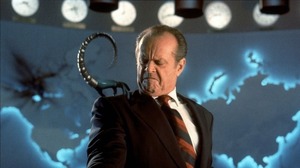
Soon after, the Martians issue what appears to be a formal apology and request to address Congress directly. The second encounter proves even more disastrous: the aliens incinerate the entire legislative chamber. In the film’s most inspired sequence, a Martian disguised as a lounge singer infiltrates the White House, only to be uncovered and eliminated by the Secret Service, triggering full-scale planetary assault. As civilization crumbles into rubble and absurdity, salvation arises from an unlikely source: a withdrawn teenager and his grandmother discover that Slim Whitman’s yodeling causes the Martians’ heads to explode. They broadcast the music across the world, unwittingly saving the human race.
Beneath its manic surface, Mars Attacks! skewers Cold War panic and B-movie nostalgia, while extending its critique to media sensationalism, political vanity, institutional failure, and the illusion of technological invincibility. The Martians represent pure anarchic force – cartoonish, sadistic, and relentless – and the film plays like a requiem for modern hubris, set to Martian cackling and warbling country tunes. Amid the wreckage, Burton offers a glimmer of hope. His survivors lack power and agency, but they endure, bearing witness and carrying forward a preservation of wonder.
Originally envisioned as a stop-motion homage to Ray Harryhausen, the film’s animation was reconstructed using CGI due to budgetary limitations. This compromise diminished the tactile charm Burton had imagined, replacing it with a glossier, more emotionally distant aesthetic. The digital effects evoked retro toy models, yet never fully aligned with the film’s analog spirit. An expanding ensemble cast and escalating production demands added strain, while Warner Bros. struggled to position the film within a crowded marketplace. Too grotesque for children and too outlandish for traditional adults, the film confounded test audiences. Released with limited promotional ty, it grossed just $37 million domestically, far below expectations.
Within that commercial disappointment, however, lies something essential: an undiluted artistic vision, realized with unwavering intent. Mars Attacks! reflects Burton’s refusal to compromise his instincts in pursuit of mass approval. Its kinship with The Hudsucker Proxy, the Coen brothers’ own studio-backed leap into stylized maximalism, now appears unmistakable. Both films faltered financially before attracting audiences drawn to their offbeat sincerity. They celebrate outsiders who stumble, fail publicly, and create with reckless devotion. Each transforms pulp imagery through obsessive design and, in its own way, signals a turning point in its creator’s journey, while temporarily closing the door on large-scale studio experiments driven by distinctive singular visions.
In hindsight, Mars Attacks! occupies a unique and cherished place within Burton’s body of work. It feels chaotic, excessive, and uneven, while also lyrical, imaginative, and disarmingly funny. Its mixture of satire and sincerity, destruction and invention, resists categorization. Its imperfections contribute to its vitality, its so-called failures enrich its charm, and its emotional core, veiled by artifice and kitsch, pulses with purpose. Far from an indulgence or misstep, the film stands among Burton’s most personal statements – a love letter to outsider expression, to misfits and monsters, and to the fierce, ragged beauty of creative defiance.