David Lynch (1977-1990)
Within American cinema, David Lynch carved out a singular path, a director whose films resisted easy categorization and whose sensibility blurred the boundaries between the everyday and the uncanny. Trained as a painter before turning to film, Lynch approached the medium with a fascination for texture, mood, and the unstable line between surface beauty and lurking menace. His work swung between the fiercely experimental and the unexpectedly mainstream, yet even in projects shaped by studio pressures his fingerprints remained unmistakable: a commitment to dreamlike imagery, an ear for unsettling soundscapes, and a willingness to let dissonance linger rather than resolve. Where many of his contemporaries embraced the sweep of blockbuster spectacle, Lynch charted a more eccentric course, creating works that unsettled, mystified, and often divided audiences, while leaving an indelible mark on the cultural imagination.
Eraserhead (1977) Lynch’s feature debut, Eraserhead, announced a filmmaker of uncompromising vision, its black-and-white imagery and industrial soundscape immersing audiences in a world at once alien and familiar. The story – centered on a man navigating a bleak industrial environment and the anxieties of parenthood – defied conventional narrative, unfolding as a nightmarish tableau. Lynch shot the film over several years on a shoestring budget, and the result was both disturbing and oddly tender, a surreal meditation on domestic dread and existential unease. The newborn child, rendered with a tactile strangeness that still unsettles, became the film’s haunting centerpiece. Eraserhead found its audience on the midnight circuit, where its combination of humor, horror, and abstraction established Lynch as a figure capable of transforming private anxieties into shared dream. The film remains a touchstone of American experimental cinema, revealing the intensity of an imagination able to translate interior states into arresting visual form.
The Elephant Man (1980) Three years later, Lynch transitioned into mainstream cinema with The Elephant Man, a period drama produced by Mel Brooks that recounted the life of John Merrick, a severely deformed man who struggled for dignity in Victorian London. The film’s black-and-white cinematography evoked both silent film and early photography, its textures at once naturalistic and poetic. John Hurt’s performance imbued Merrick with humanity and quiet resilience, while Anthony Hopkins provided a counterpoint as the doctor who struggled to reconcile compassion with curiosity. Lynch’s direction balanced narrative clarity with his fascination for the grotesque, never allowing Merrick’s deformity to overwhelm the film’s central concern with dignity and compassion. More conventional than Eraserhead, the film nevertheless bore his touch: dreamlike opening sequences, distorted sound design, and beauty and horror coexisting in the same frame. The film’s critical and commercial success gave Lynch credibility in Hollywood, proving that his vision could resonate with broad audiences without sacrificing intensity.
Dune (1984) Lynch’s foray into large-scale studio filmmaking with Dune proved the most notorious misstep of his career, revealing both the limits of his sensibility within blockbuster structures and the risks of adapting expansive source material. Tasked with bringing Frank Herbert’s sprawling science fiction novel to the screen, Lynch delivered a film dense with exposition, eccentric imagery, and abrupt tonal shifts. The production’s scale, combined with studio interference, left him unable to shape the story with coherence, and the result alienated both critics and audiences. But within the film’s excesses lie glimpses of his distinctive imagination: disturbing visions of the Harkonnens, hallucinatory dream sequences, and the clash between mysticism and machinery, a theme he would explore with greater clarity elsewhere. For Lynch, Dune became a cautionary experience, underscoring the incompatibility of his methods with conventional blockbuster demands. Although often dismissed, the film remains a fascinating artifact of a director struggling against the constraints of studio spectacle.
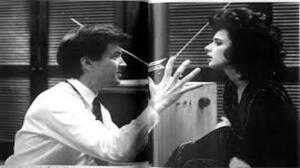
Blue Velvet (1986) With Blue Velvet, Lynch returned to a more personal scale and solidified his reputation as arguably the most daring American director of his generation. Set in a seemingly idyllic small town, the story followed a young man whose discovery of a severed ear draws him into a subterranean world of violence, sadomasochism, and corruption. Lynch staged the film with unsettling contrasts: bright suburban lawns juxtaposed with seedy nightclubs, moments of domestic calm pierced by eruptions of brutality. Isabella Rossellini’s portrayal of a woman trapped in abuse conveyed fragility and endurance, while Dennis Hopper’s Frank Booth embodied psychotic menace with terrifying conviction. Its suggestion that darkness lurked beneath the surface of ordinary life divided audiences, shocking some and mesmerizing others, but its impact was undeniable, establishing Lynch as a director willing to confront the unconscious desires and fears embedded in American culture.
Wild at Heart (1990) Lynch’s Palme d’Or-winning Wild at Heart extended his exploration of violence and desire into a flamboyant road movie that merged melodrama with surreal spectacle. Starring Nicolas Cage and Laura Dern as lovers on the run, the film combined pitch-black humor, bursts of extreme violence, and references to The Wizard of Oz into a collage of Americana pushed to extremes. Fire imagery punctuated scenes of passion, psychotic villains emerged in lurid detail, and the narrative flipped between sincerity and parody, polarizing viewers, some admiring its audacity and others dismissing it as incoherent indulgence. However, beneath its manic surface lay a portrait of love as both a destructive and redemptive force, propelling characters through landscapes of chaos toward fleeting moments of transcendence. Wild at Heart confirmed Lynch’s refusal to temper his vision for the sake of comfort, a provocateur on the boundary between nightmare and carnival.
Overall Appraisal Though his sensibility often diverged from prevailing currents, David Lynch’s films demonstrate his restless search to capture the uncanny, the grotesque, and the sublime in ways that mainstream cinema rarely attempted. With his unique ability to translate personal private dread into shared communal experience, Lynch embodied a hauntingly beautiful fascination with excess and surrealism. He insisted that cinema remain open to the irrational and the dreamlike, serving as a conduit for our unconscious fears and desires. His work immerses audiences in a world where beauty and terror dance in unsettling harmony, forever securing his place as a visionary artist of profound originality.