Joel and Ethan Coen (1984-1994)
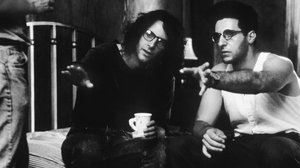
In the span of a decade, Joel and Ethan Coen transformed themselves from independent upstarts into the most distinctive filmmaking partnership of the blockbuster era, revealing a singular blend of meticulous craftsmanship, mordant humor, and formal daring, and demonstrating that popular cinema could embrace idiosyncrasy without losing momentum. Working together as writer-directors, they drew upon the conventions of noir, screwball comedy, and pulp fiction, reshaping them with an irony that never obscured their affection for genre tradition. Their early films chart the evolution of artists who approached cinema as both playful experiment and rigorous design, establishing a voice that was unmistakably confident and unique.
Blood Simple (1984) The Coens’ debut feature, Blood Simple, announced their sensibility with startling assurance. A neo-noir set in Texas, the film revolved around a bar owner who hires a private detective to kill his wife and her lover, only for the plot to spiral into betrayal, misunderstanding, and violence. The execution was taut, distinguished by the precision of its construction: shadows falling across blinds, a hand scrabbling across a blood-soaked floor, a body dragged along an unlit highway. Cinematographer Barry Sonnenfeld captured a world drenched in menace and ambiguity, while Carter Burwell’s score provided a haunting counterpoint. The Coens orchestrated suspense through the accumulation of detail, their editing transforming simple gestures into moments of unbearable tension. The film’s ironic detachment suggested a worldview in which human folly collided with fate, and its success signaled the arrival of filmmakers who could reinvent noir for a contemporary audience.
Raising Arizona (1987) With their second feature, the brothers pivoted toward comedy, creating in Raising Arizona a work of manic invention that contrasted sharply with their grim first film. Nicolas Cage and Holly Hunter starred as an ex-convict and a police officer who, unable to conceive, kidnap a baby from a wealthy family. Beneath the absurdity of this slapstick parable, filled with outrageous set pieces and grotesque supporting characters, lay a portrait of longing and desperation. The Coens choreographed action with cartoonish exuberance – most memorably a chase sequence involving hounds, police cars, and exploding diapers – while Sonnenfeld’s wide-angle cinematography emphasized the distorted physicality of their world. The film’s broad humor carried an undercurrent of melancholy, as the couple’s yearning for family collided with their incompetence, a portrait of longing and desperation presented as absurdist slapstick parable. Raising Arizona proved the Coens’ versatility, their ability to adopt a radically different tone without abandoning their precision or their fascination with characters trapped by circumstance.
Miller’s Crossing (1990) In Miller’s Crossing, the brothers returned to the territory of crime and betrayal, crafting a gangster drama that paid homage to Dashiell Hammett while reconfiguring the genre’s codes. Gabriel Byrne played Tom Reagan, an advisor to an Irish mob boss who navigates shifting alliances, double crosses, and crises of loyalty. The film’s narrative was labyrinthine, filled with reversals and oblique dialogue, its complexity offset by the elegance of its imagery. Cinematographer Sonnenfeld bathed the film in autumnal hues, with the title sequence of leaves blowing across a forest floor setting a tone of fatalistic beauty. The violence was stylized and chilling, and the dialogue carried a rhythmic precision that lent the story both gravity and irony. Less commercially successful than their earlier works, Miller’s Crossing demonstrated the Coens’ ability to elevate genre material into a meditation on loyalty, betrayal, and the shifting ground between morality and pragmatism.
Barton Fink (1991) With Barton Fink, the Coens embraced allegory, combining Hollywood satire with surreal horror and existential comedy. John Turturro played the titular character, a playwright who arrives in Los Angeles to write for the movies and finds himself consumed by paranoia and writer’s block. The dilapidated hotel where he stays became a metaphorical landscape, its peeling wallpaper and endless corridors reflecting his disintegration. John Goodman’s genial yet menacing neighbor embodied the instability of the world around him, culminating in scenes of apocalyptic violence that blurred dream and reality. A series of increasingly surreal episodes that interrogated the relationship between art, commerce, and repression, Barton Fink was awarded the Palme d’Or at Cannes and confirmed the Coens as filmmakers willing to take risks at the edge of mainstream cinema, their irony sharpened into a vision of cultural decay.
The Hudsucker Proxy (1994) The brothers collaborated with Sam Raimi to create The Hudsucker Proxy, a stylized fable of corporate America that fused screwball comedy with art-deco spectacle. Tim Robbins starred as a naïve clerk elevated to company president as part of a stock scam, only to inadvertently invent the hula hoop and spark a craze. The film’s sets were monumental, skyscrapers towering over characters dwarfed by machinery and bureaucracy, while Roger Deakins’s cinematography rendered the spaces with geometric precision. The humor leaned into caricature, from Paul Newman’s cynical executive to Jennifer Jason Leigh’s fast-talking reporter, embracing absurdity with a theatrical exuberance. Though the film underperformed commercially, it revealed the Coens’ willingness to pursue stylization to its extremes, alienating some audiences but underscoring the brothers’ refusal to conform to expectations, their cinema remaining defiantly idiosyncratic.
Overall Appraisal The Coen Brothers’ early career revealed filmmakers of remarkable control and daring, capable of shifting from noir to screwball, from gangster tragedy to surreal allegory, without losing coherence of voice. Their films combined visual precision, narrative intricacy, and tonal ambiguity, offering works that entertained even as they unsettled. And although some of these eclectic experiments met with initial commercial indifference, each helped prepare the ground for what would stand as their most fully realized artistic achievement to that point. Released in 1996, Fargo, with its seamless fusion of dark comedy, regional specificity, and existential weight, arrived as the crystallization of impulses long in motion, a synthesis of irony and tragedy that elevated their reputation to a new level of critical and cultural recognition. Today, Fargo stands as a masterful demonstration of how eccentricity and experimentation, when pursued with craft and conviction, can ripen into lasting vision, generating a form of spectacle all its own.