Crouching Tiger, Hidden Dragon
At the turn of the millennium, cinema seemed to drift between moments, suspended in the shimmer of its own reflection, uncertain whether to mourn the century it was leaving or dream the one just beginning. The world was converging, yet every film seemed to whisper of separation, returning to the weight of longing and the melancholy of connection deferred. The old romance of image and destiny lingered as afterglow, carried by characters who reached for transcendence and found only distance, mistaking motion for progress, beauty for refuge. Each sensed that love, once the axis of cinema, now floated just beyond reach, and with that sense the art form rediscovered its faith in emotion, even as it prepared to lose it.
In Almost Famous, the balance between belief and disillusionment found its most tender American form, a farewell to youth disguised as a rock chronicle. Cameron Crowe’s film moved with the warmth of memory and the ache of recognition, tracing the instant when idealism gave way to transaction, when a boy chasing truth discovered that authenticity was only another kind of performance. Every face carried the softness of something vanishing, and each song seemed to mourn the era as it dimmed – the last moment when devotion still felt pure.
Across the border, Alejandro González Iñárritu’s Amores Perros found no such tenderness. Its tangled lives, cut with jagged urgency, revealed affection as both salvation and wound, binding people together just to watch them fracture. Mexico City became a map of broken impulses – a model’s devastating injury, a teenager’s buried guilt, a hitman’s hollow faith – its velocity mirroring a new century impatient with stillness, driven by those who could not stop moving even as they destroyed what they once loved.
Steven Soderbergh’s Traffic translated that motion into a global language of compromise, its intersecting systems – politicians, dealers, addicts – unfolding across the same moral fabric, worn thin by power and denial. Yet within its intricate design, the smallest gestures carried the greatest weight: a daughter’s trembling confession, a father’s wordless comprehension, the brief honesty between people who had run out of lies. Its allure was clinical, almost exhausted – a portrait of humanity trying to believe in redemption when the machinery of excess had already outpaced it.
And then, in Hong Kong, In the Mood for Love compressed that allure into a stillness so charged it felt combustible. Wong Kar-wai’s lovers, framed by doorways and drenched in the slow pulse of time, turned restraint into the purest form of romantic fatalism; every hesitant glance, every corridor passing, became a prayer for what could never be spoken. The film’s saturated reds and deliberate rhythms transformed longing into ritual – cinema remembering how to breathe, how to make silence itself ache. Wong’s world was one of missed encounters and phantom touch, of two people moving beside the life they might have shared, and in that suspended space the century’s romantic dream flickered one last time, with a desire unbearable and a memory eternal.
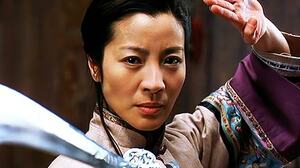
From that glow rose an ancient fable reborn: Ang Lee’s Crouching Tiger, Hidden Dragon. Reaching backward and forward at once, Lee conjured a mythic past newly alive while mourning the very belief that such worlds could still exist. Like a dream recovered from centuries of sleep – weightless yet deeply felt, precise yet overflowing with poetry – the film restored to cinema the faith that wonder could still be transformative. The story of two warriors bound by duty and haunted by ardor, and of a young woman defying gravity and destiny alike, became an allegory for a vanishing age of yearning; every movement through air denied the earth’s gravity, every stolen glance confirmed its pull.
Lee filmed the mountains, desert, and candlelit chambers like memories dissolving as they appeared – landscapes of the heart rendered in mythic brushstrokes. Chow Yun-fat’s Li Mu Bai moved with a serenity masking a sorrow too vast for speech; Michelle Yeoh’s Yu Shu Lien carried that same ache in the quiet grace of her gestures. Between them hung the eternal unfinished sentence of romance itself – a desire defined by what it could not claim, a passion that lived in the pauses between words and the moments before a blade met air.
Yet within that restraint burned vitality. In Zhang Ziyi’s Jen lived contradiction – youth rebelling against the weight of history, freedom colliding with consequence. Her flight through treetops and rooftops was cinema reawakened, defying gravity with the faith that the body could still express what language had lost. In her rebellion, there was beauty; in her fall, meaning. Between those two moments, Lee presented the fragile border between belief and surrender that defined the century’s romantic imagination.
It was both a rebirth of romanticism through form and movement, and an elegy for the sincerity that modernity would soon erode. When Li Mu Bai collapses into Yu Shu Lien’s arms, whispering the devotion he had withheld, his death feels like release – destiny surrendering to emotion. And when Jen steps to the edge of Wudan Mountain, her leap becomes the last gesture of belief in transcendence, an act of surrender so pure it can exist only in art; vanishing into mist suspended between ascent and disappearance, between the dream of love and the certainty of loss. For an instant, romanticism lived again through motion and silence, and a longing too vast for resolution.
Honorable Mentions: Stephen Frear’s High Fidelity, Darren Aronofsky’s Requiem for a Dream
And as a footnote, Billy Bob Thornton’s All the Pretty Horses carried that same yearning into the open landscape. His adaptation of Cormac McCarthy’s novel felt like a ghost from an earlier time, a story of young men crossing a border already vanishing beneath their horses’ hooves, chasing ideals too fragile for the world they inhabit. Its wide skies and spare silences carried the echo of Wong’s corridors and Lee’s mountaintops – the sense that fulfillment is inseparable from pain. All the Pretty Horses would become the decade’s forgotten elegy – a western stripped to its bones, both relentless and uncompromising.