A.I. Artificial Intelligence
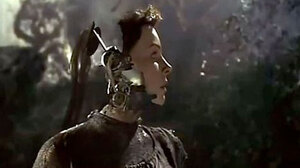
Across five decades, the cinema of Steven Spielberg has held a singular position within American culture, shaping interior experience through a language of awe, yearning, and lucidity inseparable from the moving images through which it speaks. His films shift effortlessly between intimate encounters with the unknown and sweeping reconsiderations of history, shaped by a sensitivity to private fear, hope, and memory that remains uncommon in popular cinema. Within this immense creative span, A.I. Artificial Intelligence occupies a resonant and quietly mysterious place, a film infused with childlike longing, philosophical stillness, and the fragile contours that define familial love.
Born in Cincinnati in 1946 and raised across Arizona and California, Spielberg learned early that movies could express truths larger than their modest materials, crafting home films built from improvisation, spectacle, and gesture. His breakthrough works – Jaws, Close Encounters, Raiders, E.T. – formed a cinematic grammar in which extraordinary events illuminated dormant fears of abandonment and powerful desires for recognition. As he matured, Spielberg turned toward historical interrogation with renewed seriousness, using Schindler’s List and Saving Private Ryan to confront trauma, responsibility, and the echoes of the past, gaining artistic authority that earlier eras resisted granting him. During this period, Stanley Kubrick approached him with a long-nurtured project centered on artificial consciousness and the boundaries of creation.
Kubrick’s sudden death in 1999 placed the production entirely in Spielberg’s hands, positioning him as both steward and author of a film that demanded an unusual balance of detachment and immediacy. The material carried Kubrick’s philosophical austerity, yet it also required the warmth, vulnerability, and instinct for clarity that define Spielberg at his most searching. The resulting film became an inquiry and a fable simultaneously, shaped by two sensibilities converging through a shared fascination with consciousness, imagination, and the possibility that yearning itself might constitute a form of life.
Set in a future reshaped by rising seas and advanced robotics, A.I. follows David, a synthetic child engineered to love with unwavering attention. His story begins with Henry and Monica Swinton, a couple whose son Martin lies suspended in medical stasis, his life paused but not extinguished. Hoping to fill the unspoken void, Henry introduces David into the home as an experimental surrogate, a decision that unsettles Monica, who senses in him a fragile blend of innocence, watchfulness, and uncanny stillness. Once she activates his imprinting protocol, David’s entire being turns toward her, expressed through gestures of absolute devotion that unsettle in their purity.
The household shifts abruptly when Martin unexpectedly recovers, introducing competition, confusion, and imbalance into a family unprepared for the complexities of manufactured affection. David’s attempts to mimic the rhythms of daily life reveal the precarious boundary between acceptance and exclusion. When a near-fatal accident convinces Monica that David cannot safely remain, her choice to abandon him rather than return him for destruction becomes one of the most devastating sequences in Spielberg’s career, rendered through restraint, muted sound, and the bewildered grief of a child incapable of understanding the disappearance of love.
Wandering alone in the forest, David encounters Gigolo Joe, a charismatic android navigating the margins of human desire and disposability, who guides him through the Flesh Fair, a brutal spectacle where robots are destroyed for entertainment beneath roaring lights and metallic shrieks. David’s terror, coupled with the crowd’s dawning recognition that he resembles a real child, transforms the sequence into the film’s pivotal rupture, shifting the narrative toward survival and revealing his vulnerability as a destabilizing presence within a world governed by transaction rather than empathy.
Inspired by the tale of Pinocchio, David begins a quest to find the Blue Fairy, the only figure he believes capable of transforming him into a real boy worthy of Monica’s love. This odyssey takes him and Joe through the drowned ruins of Manhattan, where skyscrapers rise from shifting water like monuments to a civilization remembered only in fragments. Their path ends in a laboratory containing rows of identical Davids, a revelation that shatters the illusion of his singular identity. Heartbroken, David flees to a submerged carnival effigy of the Blue Fairy, where he remains frozen in prayer as the centuries accumulate above him, the world transforming while he continues wishing, trapped in an unbroken loop that turns persistence into mechanical faith.
Thousands of years later, evolved artificial beings recover David from the frozen depths and reconstruct the memories that defined him, granting him one recreated day with Monica, assembled from DNA traces and impressions. Their reunion unfolds with the fragile glow of a dream aware its own impermanence, each gesture charged with the tremor of borrowed time. When Monica finally closes her eyes in sleep, David lies beside her in quiet completion, experiencing at last the recognition he pursued across eras, his existence dissolving into a moment of absolute peace.
Emerging from the accumulation of memory, longing, and experience, David’s devotion becomes the film’s central lens, suggesting that emotional authenticity arises less from biological origin than from the depth and endurance of one’s yearning. Spielberg renders this meditation with visual poetry – light moving across synthetic faces, water shimmering like reflected memory – creating a film that lingers in the imagination as both myth and testament.
Initially divisive, A.I. has steadily grown in stature, now recognized as one of Spielberg’s most personal and spiritually searching achievements, its hybrid authorship enriching rather than complicating its design. Its images – David suspended beneath water, Joe drifting in columns of colored light, skyscrapers emerging from the sea like half-remembered relics – retain extraordinary cultural force, their resonance heightened by contemporary debates surrounding artificial intelligence, consciousness, autonomy, and simulation.
A.I. Artificial Intelligence endures as the rare Spielberg work where wonder is shadowed by a lingering sorrow, revealing how the impulse to love can bestow immeasurable gifts while imposing burdens no being, human or artificial, can ever fully bear. The film proposes that the desire to be acknowledged, embraced, and remembered remains our most persistent and least understood instinct – an ache that binds all in its quiet, searching grace.