
Birth
Jonathan Glazer was born in London in 1965, raised in an environment shaped by urban density and educated within a cultural landscape where visual media was increasingly omnipresent and sophisticated. Before entering feature filmmaking, he developed his voice through music videos and commercials, a background that sharpened his sensitivity to rhythm and composition, training his eye to extract emotional clarity from minimal gesture. Unlike many directors who emerged from that world, Glazer resisted stylization as an end in itself, cultivating a visual language defined by precision and by an intuitive understanding of how stillness, when sustained, can intensify emotional charge.
His transition to feature films began with Sexy Beast, a work often remembered for its volatile performances, yet already revealing Glazer’s deeper interest in the way interior states persist long after circumstances appear resolved. By the time his next project entered development, Glazer was prepared to risk alienation in pursuit of something more fragile and exacting, a film built around a premise so disquieting it demanded absolute sincerity in execution. Released in 2004 to both bewilderment and controversy, Birth has since aged into something quieter and more enduring, revealing itself as an act of profound artistic faith shaped through restraint.
Birth opens in New York City, where Anna, portrayed with remarkable composure by Nicole Kidman, lives within the residue of a great loss. Years earlier, her husband Sean died suddenly, leaving behind an absence that shaped the architecture of her precisely structured life. The film introduces her during preparations for her upcoming marriage to Joseph, a stable and attentive man whose presence offers comfort without intrusion, yet whose relationship to Anna remains bounded by a grief that never fully receded. Glazer establishes her world through cool interiors, controlled framing, and measured movement, suggesting a life constructed around equilibrium and continuity.
That equilibrium fractures when a young boy appears uninvited, approaching Anna directly and stating, with unnerving calm, that he is Sean reincarnated, returned not as metaphor but as continuation. Glazer allows the declaration to arrive with bureaucratic clarity, its shock emerging from quiet tension in place of dramatic intensity. The boy, played by Cameron Bright, speaks with adult composure, referencing intimate details from Anna’s past marriage, including shared routines, private jokes, and emotional textures no stranger could convincingly invent. The film holds the question of authenticity in suspension, allowing certainty to remain unreachable while emotional recognition asserts its own authority.
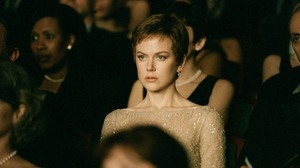
As the boy inserts himself into Anna’s life, a series of carefully observed encounters begin to test the stability she has constructed. He requests time alone with her, insists on visits to her apartment, and positions himself within her daily routine with a familiar confidence. Glazer directs these scenes with meticulous spatial awareness, framing the boy within contained adult environments that both dwarf and legitimize him. The film’s most devastating sequence unfolds inside an opera house, where the camera remains fixed on Anna’s face for several uninterrupted minutes, her emotional containment dissolving in real time as music and memory converge.
The boy’s presence gradually disrupts the social fabric surrounding Anna. Her fiancé grows uneasy, her family responds with skepticism and fear, and her community retreats into polite concern, unwilling to engage fully with the implications of what is unfolding. Glazer resists melodrama, presenting each response as reasonable within its own limits, and allowing Anna’s isolation to deepen through accumulation instead of rupture. The film’s tension emerges from this erosion of shared reality, as Anna finds herself increasingly alone inside an experience that demands a decision no one else is willing, or able, to make.
The final act unfolds as a series of emotionally charged reckonings, distinct from conventional narrative resolution. Glazer stages Anna’s last encounter with the boy with extraordinary restraint, permitting silence and distance to perform the work exposition might otherwise attempt. The boy ultimately relinquishes his claim, departing Anna’s life as abruptly as he entered it, leaving behind no confirmation, no explanation, and no stable boundary between truth and longing. The film closes with Anna returning to the life she had been preparing, her face composed, her world restored yet irrevocably altered by an encounter that resists dismissal as illusion and denies acceptance as certainty.
Central to Birth’s power is its commitment to observation rather than explanation. Glazer declines visual cues or musical signals that might guide interpretation, allowing the emotional consequences of each interaction to define the experience’s reality. Anna’s exchanges with the boy are marked by tenderness shadowed by terror, as she moves between recognition and restraint, drawn toward a connection that threatens to dissolve the boundaries she painstakingly rebuilt. In these moments, the film confronts the possibility that love, once formed, may persist beyond the limits of time, age, and social order.
The production of Birth demanded an unusual degree of trust from its performers, given the material’s sensitivity and the ease with which it could have collapsed into sensationalism. Glazer worked closely with Kidman to sustain a performance shaped by restraint, allowing micro-expressions and shifts in posture to convey emotional complexity. The cinematography favors long takes and static compositions, encouraging the audience to remain present within discomfort, resisting the impulse toward release. Alexandre Desplat’s score, used sparingly, operates as an undercurrent, reinforcing the film’s commitment to ambiguity. Upon release, however, controversy often eclipsed intention, with attention drawn toward premise over execution.
Over time, Birth has emerged as one of the most rigorous and emotionally courageous works of its era, its reputation strengthened by the very restraint that once confounded audiences. In an industry increasingly oriented toward reassurance and clarity, the film stands as a testament to unresolved feeling, and to the danger inherent in assuming that grief will follow a linear path toward closure. It remains a work of extraordinary intimacy and discipline, approaching the ineffable through attention and patience. For those willing to remain within its stillness, Birth offers recognition rather than answers, a reminder that the most enduring experiences in art, as in life, often arrive without permission and depart without explanation.