Oliver Stone (1986-1991)
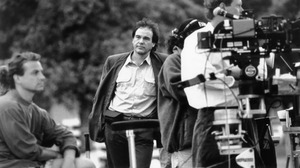
Few directors of the blockbuster era pursued American history with the intensity of Oliver Stone, whose work sought to render the nation’s political and cultural upheavals in images of fevered clarity. Trained as both screenwriter and filmmaker, Stone approached cinema with a belief in its power to provoke, unsettle, and awaken, a conviction that gave his films a polemical urgency even when their methods seemed excessive. His style merged classical storytelling with formal experimentation, relying on rapid editing, layered sound, and a willingness to disrupt conventional narrative flow in order to approximate the turbulence of memory and collective trauma. At a moment when Hollywood’s dominant current leaned toward escapism, Stone committed himself to confrontation, reframing national myth through a lens of moral ambiguity and relentless critique.
Platoon (1986) Stone’s breakthrough as a director came with Platoon, a Vietnam War drama informed by his own combat experience. The story follows a young soldier, played by Charlie Sheen, who finds himself torn between two sergeants embodying conflicting visions of war: one humane, the other brutal. Stone staged the film with a raw immediacy, using handheld cameras and natural light to convey the chaos of jungle warfare, its combat scenes refusing romanticism and its portrait of a divided platoon mirroring the divisions of a nation still haunted by the war. The Academy’s recognition of the film confirmed Stone as a director capable of translating personal recollection into popular success, and established Vietnam as a subject that would dominate much of his early work.
Wall Street (1987) Stone shifted from battlefields abroad to boardrooms at home, capturing the ethos of the 1980s with Wall Street. The narrative centers on a young stockbroker seduced by the power and corruption of corporate raider Gordon Gekko, a role delivered with electrifying menace by Michael Douglas. Stone’s direction emphasized the seductive rhythms of trading floors, the sterile luxury of corner offices, and the intoxicating pull of greed disguised as ambition. The famous declaration that “greed is good” distilled the spirit of an era, though Stone framed it as caution rather than endorsement. His eye for detail gave the film an authenticity that elevated it beyond melodrama, standing as a cultural document of a decade in which financial speculation became a dominant force.
Born on the Fourth of July (1989) Returning to the subject of Vietnam, Stone crafted one of his most ambitious works with Born on the Fourth of July. Based on the memoir of Ron Kovic, the film traces the journey of a patriotic youth whose war injury leaves him paralyzed and whose disillusionment transforms him into an antiwar activist. Tom Cruise delivered a career-defining performance, capturing the anguish of a man who feels both betrayed by his country and compelled to confront it. Stone orchestrated the film with a sweeping emotional scale, his camera shifting from the sunlit idealism of suburban America to the searing violence of combat and the despair of hospital wards. Kovic is portrayed as both victim and agent, his personal suffering entwined with broader questions of national conscience. Through his story, Stone continued his effort to reframe Vietnam as lived experience, confirming his status as the cinematic chronicler of the war’s human cost.
The Doors (1991) With The Doors, Stone turned his attention to the counterculture, crafting a portrait of Jim Morrison and his band that embraced the excesses of both subject and style. Val Kilmer’s uncanny performance as Morrison gave the film a center of volatile energy, while Stone’s direction sought to approximate the hallucinatory swirl of the late 1960s. The concert sequences pulse with kinetic movement, the camera diving and tilting as though intoxicated by the music, while interludes of surreal imagery attempt to evoke the drug-fueled vision that shaped Morrison’s persona. The film sacrifices narrative coherence in pursuit of immersion, often drifting into impressionistic tableaux that privilege atmosphere over clarity. This indulgence diminished the film’s impact, yet as an evocation of an era’s psychedelic intensity it achieves a vivid, if uneven, power. Stone treated Morrison less as subject than as symbol, a figure through whom he explored the allure and destructiveness of freedom unbound.
JFK (1991) In the same year, Stone delivered his most controversial and audacious film with JFK, a sprawling inquiry into the assassination of President Kennedy. Centered on New Orleans district attorney Jim Garrison, played by Kevin Costner, the film weaves together courtroom drama, conspiracy theory, and historical collage with a restless, fragmented style. Stone employed multiple film stocks, rapid editing, and overlapping sound to create a visual language that mirrored the instability of historical truth. The narrative proceeds with relentless momentum, building a case less through evidence than through atmosphere, conviction, and rhetorical force. The film ignited debate about history, memory, and the responsibilities of art, its critics decrying its liberties with fact and its defenders praising its audacity in questioning official narratives. Ultimately, the film’s cultural influence was undeniable, rekindling public debate about the assassination and demonstrating cinema’s ability to shape historical imagination as powerfully as journalism or scholarship.
Overall Appraisal Oliver Stone positioned himself as one of the most provocative directors of the blockbuster era, a filmmaker who sought not merely to entertain but to redefine the relationship between cinema and history. His films blended popular accessibility with formal experimentation, their narratives propelled by passion and their images marked by a restless search for truth that often blurred into speculation. Platoon evoked the personal horror of the Vietnam War, before Born on the Fourth of July reframed the conflict as a national wound, culminating in JFK’s transformation of political conspiracy into a cinematic spectacle. Collectively, these works reveal a director convinced of the power of cinema to shape the collective memory, to question authority, and to provoke debate, even at the risk of excess. The contribution of Stone lies in his refusal to treat film as neutral entertainment; for him, it was a medium of interrogation, one that demanded audiences wrestle with the political and cultural fractures of their time.