Tim Burton (1988-1996)
Tim Burton’s arrival in Hollywood brought with it a sensibility that seemed at once gothic, whimsical, and wholly distinct from the prevailing currents of blockbuster cinema. Trained as an animator and illustrator before moving into directing, Burton approached film with a visual imagination steeped in expressionism, fairy tale, and comic book exaggeration. His work revealed a fascination with outsiders, misfits, and fantastical worlds rendered with both playfulness and melancholy. While his films succeeded within the commercial structures of Hollywood, their tone and imagery bore the stamp of an eccentric personal vision, transforming dark themes into entertainment and infusing spectacle with tenderness. From supernatural comedy to superhero myth and suburban fantasy, Burton crafted stories that spoke as much to alienation as to amusement, shaping a body of work that redefined how strangeness could thrive within mainstream cinema.
Beetlejuice (1988) Burton’s breakthrough came with Beetlejuice, a supernatural comedy that combined anarchic humor with elaborate visual invention. The story of a recently deceased couple attempting to reclaim their home from the living provided a framework for Burton’s blend of the macabre and the comic. Michael Keaton’s manic performance as the mischievous ghost Beetlejuice became the film’s chaotic center, a figure of grotesque energy who disrupted both the narrative and the visual order of the film. The production design, filled with warped architecture, exaggerated colors, and stop-motion effects, reflected Burton’s background in illustration and animation, turning the afterlife into a carnival of the grotesque. The film established his reputation as a director whose imagination could translate eccentricity into box-office appeal, marking him as a figure who could bring the surreal into commercial success.
Batman (1989) The following year, Burton directed Batman, a project that redefined the possibilities of the superhero film. Eschewing the camp of earlier iterations, he constructed Gotham City as a gothic metropolis of towering shadows and industrial menace, designed with expressionist grandeur by Anton Furst. Keaton’s casting as the title character initially sparked skepticism but proved effective, his brooding restraint contrasting with Jack Nicholson’s flamboyant Joker. Burton balanced spectacle with atmosphere, ensuring that the city itself became as much a character as its inhabitants. The film’s mixture of darkness, humor, and stylization resonated with audiences, achieving immense commercial success and setting the tone for decades of superhero cinema. While constrained by studio demands, Batman demonstrated Burton’s ability to channel his visual sensibility into large-scale projects without sacrificing individuality, securing his position as a major director within the blockbuster landscape.
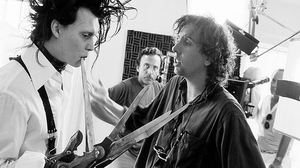
Edward Scissorhands (1990) With Edward Scissorhands, Burton delivered his most personal and enduring work, a modern fairy tale that crystallized his fascination with the outsider. Johnny Depp starred as Edward, an artificial man with blades for hands, whose innocence collides with the conformity of suburban life. Burton staged the story with delicate contrasts: pastel houses and manicured lawns set against Edward’s dark, expressionistic castle; moments of comedy interwoven with passages of lyrical melancholy. Depp’s performance, restrained and vulnerable, embodied the pathos of a figure both childlike and tragic, while Winona Ryder provided a counterpoint as the girl who glimpses his humanity. The film’s imagery – hedges sculpted into fantastical forms, snow falling from Edward’s creations – achieved a poetic resonance that transcended narrative. More than a story of love and rejection, Edward Scissorhands became an allegory of creativity, alienation, and the fragile beauty of difference. For Burton, it represented the most complete expression of his vision, a film that fused style, story, and sentiment into a work of lasting cultural impact.
Ed Wood (1994) Burton’s affection for eccentricity found a different expression in Ed Wood, a biographical comedy-drama about the filmmaker long regarded as the worst director in Hollywood history. Depp portrayed Wood with wide-eyed enthusiasm, presenting him not as an object of ridicule but as a dreamer whose passion for filmmaking eclipsed his lack of skill. Shot in black-and-white, the film evoked both the period it depicted and Burton’s admiration for its subject, while Martin Landau’s Oscar-winning performance as Bela Lugosi added a note of poignancy. Burton resisted the temptation to mock, instead creating a work of surprising empathy, one that suggested failure could carry its own dignity. Though less commercially successful than his earlier films, Ed Wood earned critical acclaim and demonstrated Burton’s ability to channel his style into a more restrained and character-driven narrative, expanding the scope of his artistry beyond gothic fantasy.
Mars Attacks! (1996) Burton returned to satirical spectacle with Mars Attacks!, adapting a set of 1960s trading cards into a science-fiction comedy of invasion and absurdity. The film assembled an ensemble cast – Nicholson, Glenn Close, Annette Bening, Pierce Brosnan – only to subject them to cartoonish destruction at the hands of gleefully grotesque Martians rendered in computer-generated imagery. Burton embraced chaos, orchestrating scenes of mass annihilation with a spirit of parody that mocked both Cold War paranoia and disaster-movie clichés. The humor was broad, the violence gleeful, and the tone so arch that audiences were divided, leaving the film a commercial disappointment. Yet its exaggerated style and satirical bite revealed Burton’s refusal to temper his eccentricity even within large-scale projects. Though uneven, the film remains emblematic of his commitment to eccentric imagination, his delight in spectacle as satire rather than solemnity.
Overall Appraisal Tim Burton transformed gothic eccentricity into mainstream spectacle, shaping worlds where the grotesque and the tender coexisted with surprising harmony. From anarchic comedy to superhero myth and biographical homage, his films revealed a sensibility at once playful and melancholic, fascinated by outsiders and the uncanny beauty of strangeness. With Edward Scissorhands, he reached the most refined expression of that vision, creating a modern fairy tale whose imagery and emotional resonance secured his place as one of the defining stylists of his generation. This achievement gave retrospective coherence to the films that preceded it, demonstrating how comedy, fantasy, and spectacle had always been moving toward a singular fusion of style and feeling; proof that eccentric imagination could reshape the system, leaving behind images that remain embedded in the cultural imagination.